Tulamben - Amed
Bali
Menu
Close Meu
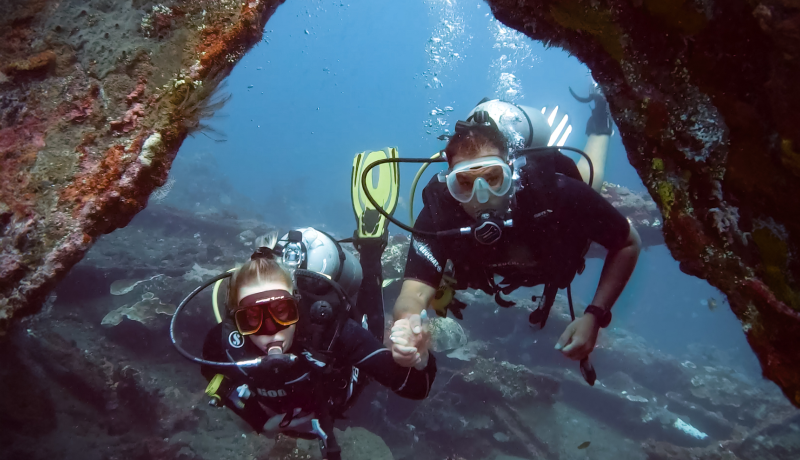
Deep diving presents a different universe that exists underneath the ocean that offers experiences that are not available in recreational scuba diving. For a straightforward definition, deep diving is defined as any plunge that goes beyond 30 meters (100 feet) and thus comes with its own unique set of challenges and rewards. While diving on shallow waters is pretty straight forward, it is worth noting that deep diving has more intricacies and requires in-depth knowledge and appropriate gear for the safety and pleasure of the diver.
Whether one is just starting to dive or has a few dives under his belt, deep diving has a lot to offer any diver, ranging from shipwrecks, deep-sea coral reefs, to even geological formations lying well beneath the wave ends. But before you plunge into it, it is crucial to understand what deep diving is all about.
While exciting, deep diving comes with its own sets of risks. The deeper one goes, the higher are the pressure levels to which the body is exposed in the water. That means you can be really much more concerned with air supply management, decompression times, and monitoring your equipment at greater depths. But don't worry, you can manage these risks with the right preparation and understanding.
Overall, enhancing one’s safety during the accrual of depths involves both motivational training and the appropriate resources. It is quite obvious that a mere intro to diving skills will not be enough, advanced certification courses mean diving training you receive will be preparing you for progressing deep in the recesses. You will also use Nitrox that is going to be a gas mixture that aids in breathing at the depth more safely.
The time taken to train and gear up properly will not only help protect you from possible risks but also enjoy the dive a whole lot more.
With deep diving, your body will have to change with every increase in pressure. The important conditions to be concerned with are those such as nitrogen narcosis and decompression sickness. Nitrogen narcosis is a condition experienced while diving, which is akin to a slight state of drunkenness that can impair one’s judgment. Additionally, there is decompression sickness, also popularly known as ‘the bends’ that occupies one when they ascend to the surface in a short time. Consequently, it leads to the development of nitrogen bubbles in the tissues.
Any deep diver should understand such reactions and how to avoid them. Slow ascents, proper breathing techniques, and decompression stops will make the difference.
To begin with, if any deep sea diving is on the cards for you, the first and foremost thing that needs to be done is obtain certification.
Courses like that of PADI Deep Diver will help you learn the basic concepts and help you get accustomed to comfortable deep diving techniques. It will equip you with skills on how to plan for deep dives, handle complex deep sea diving gear and other deep sea diving related emergencies.
You are going to be in the capable hands of instructors who will ensure that you do not get hurt as you learn. The certification isn't just a requirement, it's your key to fully enjoying deeper parts of the ocean.
Deep diving isn't something one can just jump into; there has to be a kind of preparation beforehand. Along with certification, you will be in physical conditioning so your body can take the stress of deeper dives. Shallow dives will build your endurance and get you comfortable with your equipment.
The second most important step in scuba diving is to perform proper planning of dives. You will be required to make provisions for factors such as air consumption, temperature, and the length of time you are allowed to safely stay at certain depths. Indeed, all these preparations will help you experience both a safe and memorable first deep dive.
First and foremost, it is necessary to choose a good training provider. Look for highly-rated instructors and diving centers with accredited certifications with experienced trainers. Don't be afraid to ask about their qualifications and make sure they offer valid certification that will be recognized worldwide.
This thrill isn't the only reward when deep diving, you can be part of helping to conserve our oceans. Going more deeply into such waters, divers support scientists and conservationists in collecting vital data on underwater ecosystems that seldom get accessed. The more we know about such environments, the better we'll be at protecting them.
In many locations around the globe, groups of divers are contributing to conservation efforts by simply monitoring a coral reef for its health or by cleaning underwater debris. Your interest might be transformed into being part of something much larger than just that simple interest of yours.
There is something nearly tranquil in the feeling of being deep in the ocean. Many divers would describe it as meditation because of the capability to disconnect from everyday noise. Deep diving enables you to be all-in on that particular moment, it has some grounding quality, which provides peacefulness and mental clarity.
It's also an excellent confidence booster, with each dive completed you attain your personal best, and each time you challenge yourself to go a little deeper, you learn how to confront difficulties with grace and poise. And the deeper you dive, the more you appreciate the incredible beauty and silence of the underwater world.
Some believe deep diving is reserved for professionals, which is absolutely not true. With good training, even a recreational diver can go to deeper depths without any problems. Another myth associated with deep diving is that it is innately dangerous. The fact of the matter is that it comes with risks, just like many other adventure sports. Safety in deep diving involves proper training, planning, and preparation.
Well, it's quite natural to fear the unknown, but once you start deep diving training, you'll find that most of your anxieties can be managed by knowledge. The more you understand how your body reacts at depth and how to use the right equipment, the more confident you are going to feel about your abilities.
Such fears can only be overcome through practice or learning from experienced divers, and this will avail a whole new world of underwater adventure.
It's not just about going deeper, it's about stretching your own limits with respect to the ocean and the incredible ecosystems in them. Get the right training, proper equipment, and mentally and physically prepare for some safe exploration of the wonders below 30 meters. And who knows, you may find that you discover a new passion or make some worthwhile contribution to marine conservation.
Recommended deep diving spots that you can visit are Boga Wreck which has a depth of 18 - 40 meters. This location is perfect for starting your first deep diver, because there are shipwrecks, VW cars and other interesting underwater animals. Making this place ideal for you to practice deep training diving.
Jalan Tukad Abu, Tulamben, Kubu, Karangasem - Bali 80852
+62 812-8000-7982
Designed by Bali Web Design